IPv4 vs IPv6: What’s the Difference?
The short version
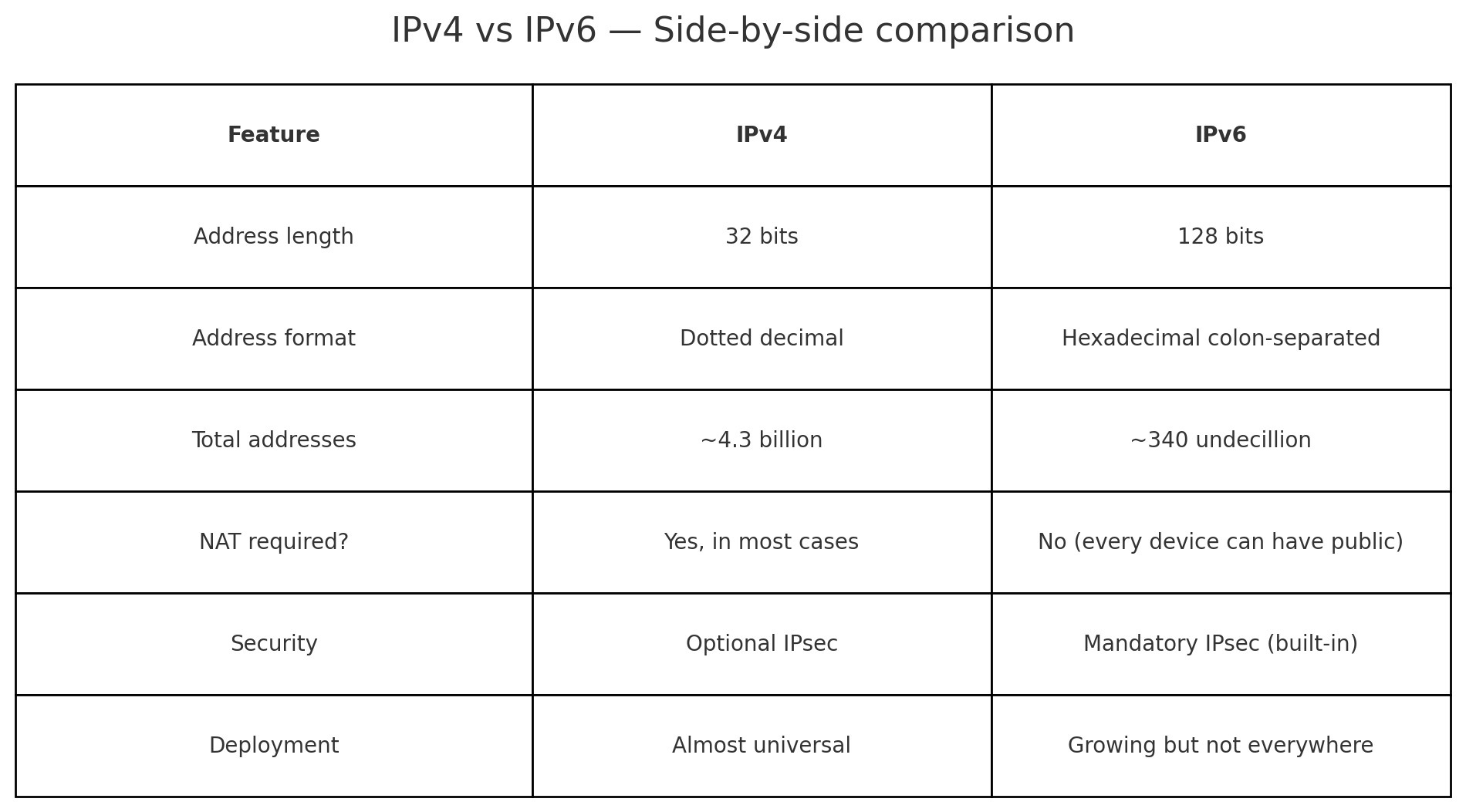
IPv4 is the old addressing system that powers most of today’s internet. It uses 32-bit addresses and can only provide about 4.3 billion unique IPs. IPv6 is the modern replacement with 128-bit addresses, giving us more addresses than atoms on Earth. Both coexist today.
---
IPv4 in plain English
- **Format:** Four numbers 0–255, separated by dots (e.g.,
192.168.0.1) - **Size:** ~4.3 billion total addresses
- **Launched:** 1983
- **Problem:** We ran out of available IPv4 blocks due to the explosion of devices
Workarounds include NAT (network address translation), where many devices share a single public IPv4, and private ranges (192.168.x.x, 10.x.x.x).
---
IPv6 basics
- **Format:** Eight groups of hexadecimal, separated by colons (e.g.,
2001:0db8:85a3::8a2e:0370:7334) - **Size:** ~340 undecillion addresses (3.4 × 10³⁸)
- **Launched:** 1998
- **Advantages:**
---
Side-by-side comparison
---
Why both still matter
Most networks, ISPs, and websites **dual-stack**: they serve both IPv4 and IPv6. Some regions and mobile carriers push IPv6 harder, but globally, IPv4 is still heavily used.
If your ISP or hosting doesn’t support IPv6 yet, you’re not alone. But adoption keeps growing because:
- IPv4 addresses are expensive (sold and rented on secondary markets)
- IPv6 future-proofs the internet of things (billions of devices)
- Governments and big tech companies are mandating IPv6 support
---
How to check your connection
Visit any IPv6 test site or use this command:
Linux/macOS
Windows
If it responds, you’re running IPv6 alongside IPv4.
---
Wrap up
IPv4 built the internet, but it’s out of room. IPv6 solves the problem with astronomical address space and modern features. For most users, the transition is invisible — your device just works. But under the hood, IPv6 is what will keep the internet growing for decades.